The Intelligent Organization
May 2026 · AI Transformation · 6 min read
Architecting AI for Durable Competitive Advantage
The Case for Firm-Specific Intelligence
Foundation models have crossed critical capability thresholds in rapid succession. Models today reason through multi-step problems, write and execute code, interpret complex documents, and orchestrate sequences of tool calls. Two years ago, capabilities like these would have seemed implausible. Progress is steady, with each generation improving reasoning depth, factual accuracy, and the capacity to follow nuanced instructions. For enterprises built on knowledge work such as analysis, synthesis, drafting, and decision support, this represents a historic opportunity. The question is no longer whether AI can assist with complex professional work; it can. The question is how to design systems around these emerging technologies that create the trust and reliability needed to deploy at scale.
The same breadth of training that gives foundation models their broadest capabilities also creates their most significant limitation for enterprise use: overgeneralization. A model trained on internet data produces outputs that mirror online content, useful but lacking specificity. The gap between an impressive demo and a production-grade deliverable is one of domain knowledge, not raw capability. There are several approaches to bridging this divide. Prompt engineering standardizes task instructions, retrieval-augmented generation embeds relevant context at inference, and fine-tuning adapts model weights to domain distributions. Each is necessary, but in isolation they act as point solutions. What enterprises need is an integrated system that captures institutional knowledge and guides how models operate in context.
This leads to the central thesis: durable value in enterprise AI will accrue to those who successfully encode institutional knowledge into deployed systems, incorporate feedback from the people who interact with those systems, and create learning loops that enable continuous self-improvement and compound in value over time. The first imperative is knowledge encoding. Every firm possesses its own historical work artifacts, analytical conventions, and domain expertise that no foundation model carries natively, and the firms that structure this knowledge into retrievable context gain an immediate advantage over those running generic models against generic prompts. The second is incorporating feedback: when a practitioner corrects a generated output, that correction carries a signal about what “good” looks like in this specific context, allowing the system to improve with every interaction in ways that static deployments cannot. The third, and most consequential, are the learning loops that emerge when firm knowledge and feedback are incorporated continuously: each workflow draws on the accumulated knowledge from prior runs, each human interaction refines the system’s understanding, and the resulting intelligence creates a compounding advantage for the business.
The Five-Step Process
Translating this into practice requires structure. I’ve created a five-step implementation process based on the concepts above. The process also has two guiding principles: minimize required human touchpoints and maximize retrieval of relevant information.
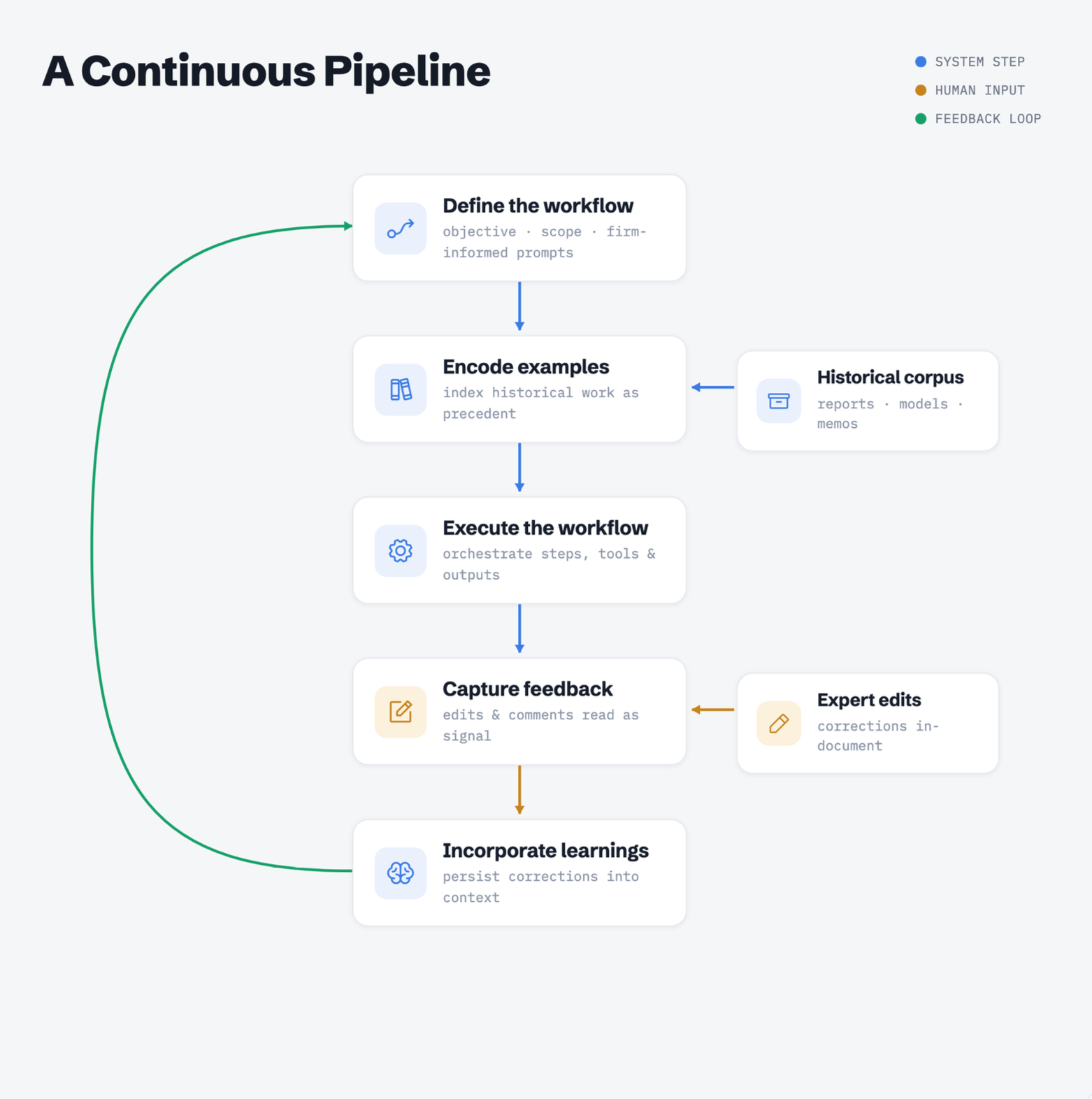
Define the Workflow
Professional work is decomposed into structured workflows, each with an objective, scope, sequence of steps, input data, and output artifacts. The central component is the human-authored prompt for each step. Rather than a generic directive like “analyze this document,” it gives a specific, firm-informed instruction: “Extract trailing twelve-month financials, normalize for non-recurring items per our underwriting guidelines, and flag line items where presented figures diverge from raw data by more than five percent.” Workflows vary considerably by industry. A credit fund defines a deal screening workflow, a life sciences team performs a clinical trial literature review, and a consumer tech PM develops a competitive landscape analysis. In each case, the common goal is to convert tacit best practices into an explicit format that can be executed on demand.
Encode Historical Examples
Most organizations already hold years of firm knowledge in the form of reports, models, memos, slide decks, and revised deliverables. This corpus is used to bootstrap the system with institutional memory: parse historical outputs to extract structural and stylistic patterns, infer standard analytical approaches, and build retrieval indices so the system can draw on relevant precedents for new tasks. Across many samples, the intelligence platform becomes adept at handling nuance and identifying edge cases. When responding to a new request, the system retrieves the most relevant historical examples as context, ensuring outputs align with business standards.
Execute the Workflow
An orchestration layer runs workflows as a directed execution plan. Each step in the plan carries forward context, invokes required tools (document parsers, spreadsheet generators, retrieval engines, external APIs), and delivers structured outputs for the next step. This preserves key information and precedents so that final outputs are immediately usable, whether Word memos, Excel models, PDFs, or structured data. Optional confidence thresholds can help human reviewers prioritize effort. Recently, an emerging ecosystem of open-source, industry-specific plugins has significantly expedited the piloting of workflow automation using generative AI.
Capture Feedback
Practitioners interact with artifacts in their native formats, editing a memo in Word or adjusting a model in Excel. The system is designed to capture both explicit feedback, such as comments and annotations, and implicit signals: edits indicate shortcomings, while sections left untouched indicate success. Significant restructuring reveals deeper misalignments. No formal evaluation framework is required, because the act of finishing the work is itself the feedback signal. When the initial output and the finished product diverge significantly, folding corrective guidance from a human expert back into the workflow prompts should meaningfully improve future runs.
Incorporate Learnings
Finally, the continuous learning paradigm requires feedback persistence and availability for future executions. Both explicit corrections and inferred best practices are distilled into retrievable context. This does not require any changes to the underlying model. Rather, robust context management (updating prompts, adding finalized outputs to the example pool, enriching retrieval indices) adjusts the firm-specific profile dynamically. Over time, the system converges toward the firm’s standard of quality with decreasing need for human intervention.
The Vision: An Intelligent Enterprise
The ideal is an enterprise where intelligence flows across the organization through a unified orchestration layer. This layer does not replace existing systems such as CRMs, data providers, and document repositories. It sits above them, reasoning across them and drawing on their data as context for workflows that span multiple systems. Access to the firm’s collective body of knowledge becomes democratized.
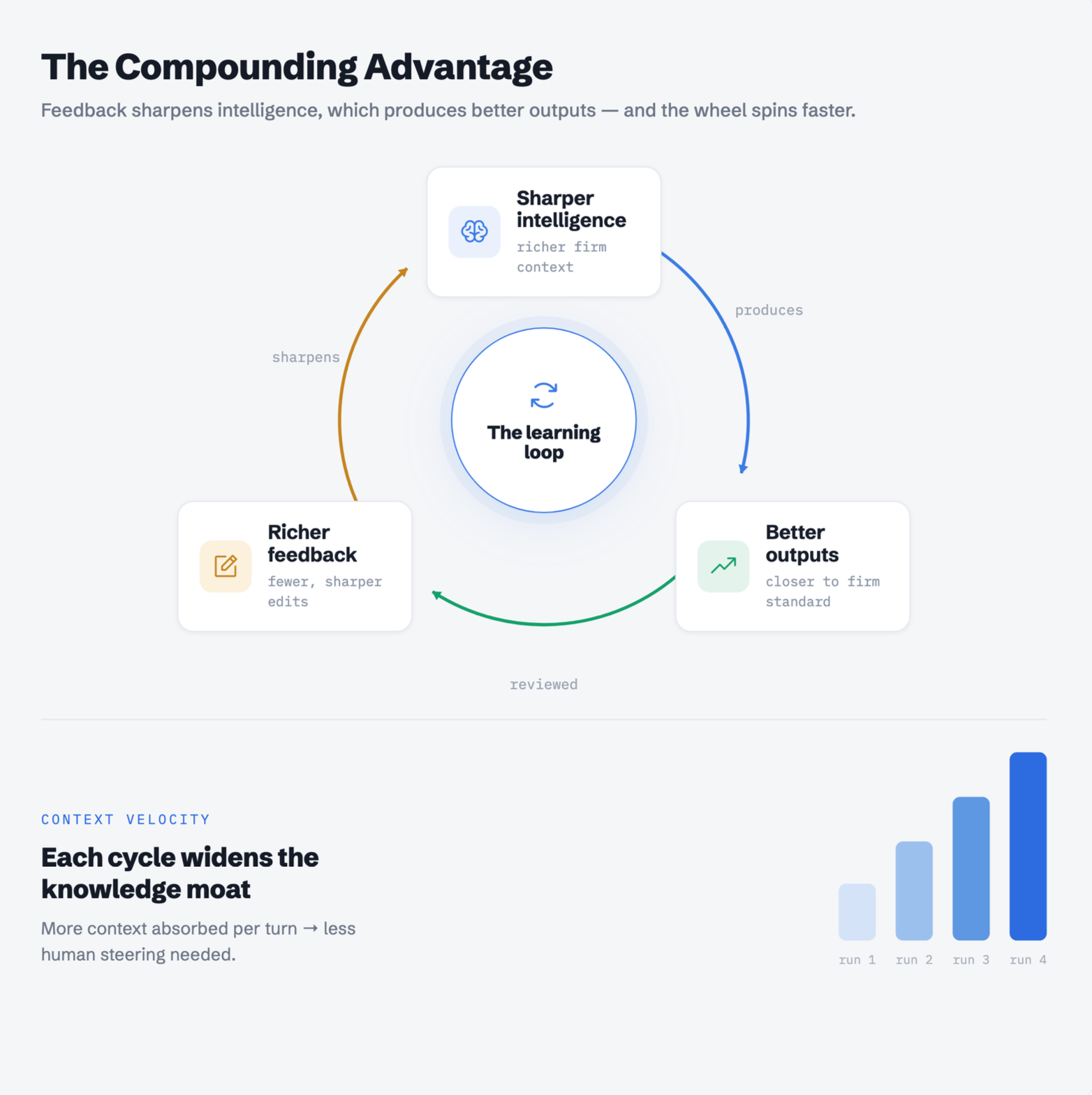
Organizations that successfully adopt this framework will find themselves benefiting from learning loops that improve with every execution. As feedback improves intelligence, which in turn produces better outputs, an information flywheel is created. Firms that fail to deploy such systems at scale will not simply lag; they will fall progressively further behind. The resulting competitive advantage is a knowledge moat rather than a technological one. In this future, the defining factor separating outperformers from the rest is “context velocity,” the rate at which new information and corrections are absorbed into the core intelligence engine.
The ultimate promise is an enterprise that learns continuously from its own people. This is fundamentally different from traditional enterprise software, which delivers static functionality that does not improve with use, and from today’s generation of AI tools, which offer powerful but generic capabilities. The trajectory points toward the minimum-touchpoint, maximum-context ideal: the system incorporates all relevant information the firm possesses with decreasing need for human steering. Our role as human experts evolves from operator to editor to strategic reviewer. We intervene on the decisions that most benefit from personal experience and judgment, rather than because the system needs constant guidance. The organizations that make this commitment earliest will find themselves not merely using AI but building an intelligence that is uniquely their own.