Bridging the Demo-to-Production Gap
June 2026 · AI Transformation · 5 min read
A working demo is the easiest part of an AI project and the most misleading. With today's tools, a capable team can stand up something convincing in an afternoon: it takes sample inputs, returns a clean answer, and shows well in a meeting. The trouble starts when that prototype has to run every day, on real data, inside systems that were never built for it, under rules that punish mistakes. The divide between a demo that impresses and a system that can be deployed is where most AI projects stall. Closing it is less about a better model than about several critical processes that a quick prototype skips. This piece highlights a few of them.
System integrations
A demo runs on a handful of files someone dropped into a folder. A production workflow has to reach the systems where the work actually lives: the document store, the system of record, the CRM or EHR, and the queue that assigns work to people. Integration is the unglamorous work of wiring those connections so data flows in and results flow back without a person copying and pasting between screens. It is also where most of the hidden complexity sits: authentication, rate limits, retries when a service is down, and a record of what was read and written. A prototype that produces a perfect answer in isolation is worth little if someone still has to move that answer by hand into the system that uses it. Getting integration right is what turns an impressive prototype into a solution that can be embedded in a real-world business process.
Key stat: In an April 2026 Cloudera survey of 1,270 IT leaders, nearly 80% said their AI initiatives are held back by limited data access across their systems — even as 96% report already wiring AI into core processes. The integration, not the model, is the bottleneck. (Cloudera, 2026)
Prompting & context engineering
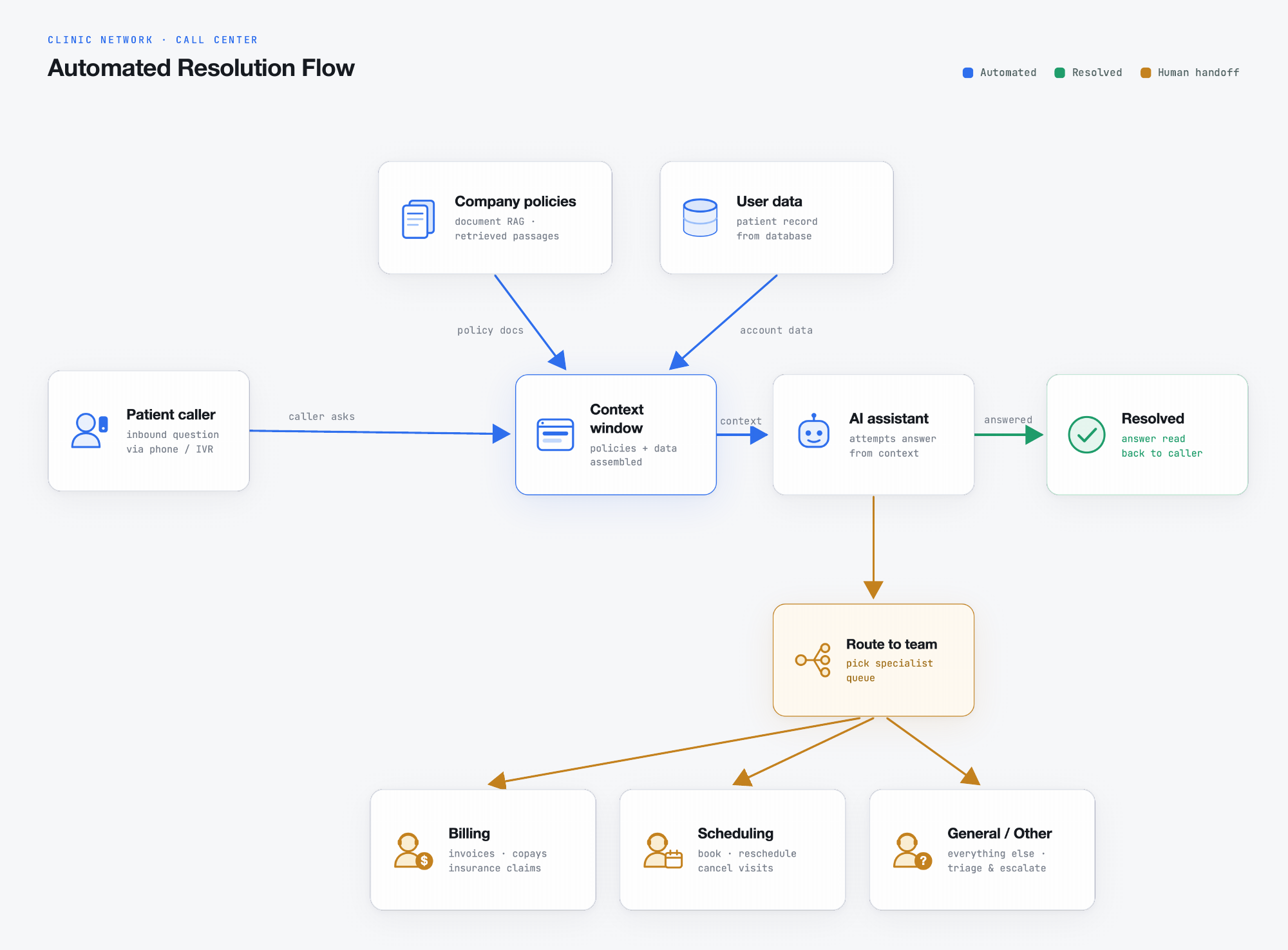
A demo is usually tuned, knowingly or not, to a small sample set. Production inputs are messier and more varied, and the instructions have to hold up across all of them. This is where deliberate prompt and context engineering earns its place: specifying the task precisely, addressing the edge cases, fixing the output format, and, just as important, controlling what the model sees on each request. Context engineering is the discipline of supplying the relevant policy, the right records, and the prior steps of a workflow while leaving out the noise that wastes budget and diminishes accuracy. The demo version works because a person picked the input; the production version works because the system reliably assembles the right context for inputs no one has seen yet.
QA & eval sets
A demo is judged by whether it looked right on a few curated examples. A production system must be judged by how often it is right across many representative cases, and that requires measurement. An eval set is a fixed collection of historical inputs paired with "the answer key", used to baseline accuracy, cost, how frequently human intervention is needed, and how effectively nuance is handled. Without it, "it seems to work" is the only available standard, and it's the standard that lets a flawed system reach production. With the eval groundings, every subsequent change, whether a cheaper model, a new prompt, or an added step, can be validated against the same baseline before it ships. Building the eval set is often the moment a team learns how well their solution actually performs, and it's the most crucial thing separating a deployable system from a hopeful one.

Security & governance
A demo answers to no one. A production system in financial services or healthcare answers to compliance officers, auditors, and regulators, and it touches data that carries real obligations. Security and governance are the controls that make deployment defensible: access limited to the people and systems that need it, sensitive data handled and stored under the relevant rules, an audit trail of what the system did and why, and a human review step where the stakes call for one. Governance also covers the questions a demo never raises: who owns the output, how errors are caught and corrected, and what happens when the model is wrong. In regulated industries this is not a final polish; it is frequently the gate that decides whether a project is allowed to go live at all, and it is far cheaper to design from the outset than to retrofit.
None of this diminishes the value of a fast prototype. In fact, a vibe-coded demo is often the fastest way to surface the early user feedback that shapes design decisions and to gauge whether the project is worth the significant time and effort to productionize. The mistake is treating that demo as nearly finished when it is closer to a sketch. The work that follows is what turns a convincing prototype into something an organization can actually run: integrating with real systems, engineering prompts and context for cases no one anticipated, measuring quality with evals, and building in security and governance. Scoping that work honestly from the start is the difference between a pilot that fizzles out and one that earns its place in production.